
Pruning
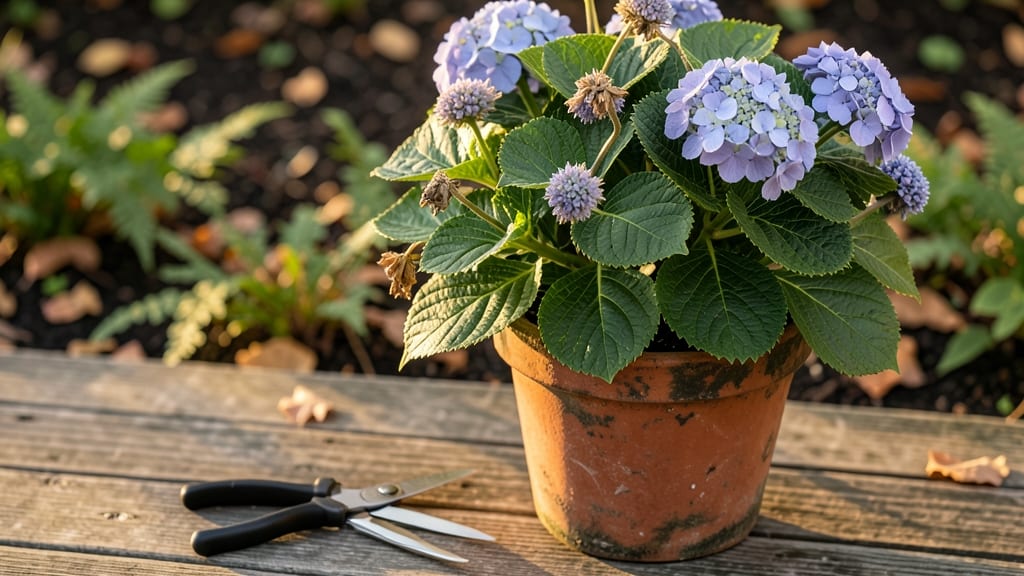
Yes, you should deadhead hydrangeas in pots to maximize blooms, especially for mophead and bigleaf varieties. Trim faded flowers just above the first set of leaves or buds after they finish blooming, but wait until late winter to prune old-wood types like oakleaf hydrangeas.
Deadheading potted hydrangeas isn't just about tidying up—it's a growth hack that tricks the plant into producing more flowers. 🌿 When you remove spent blooms, you're redirecting the plant's energy away from seed production and toward developing new buds.
Container-grown hydrangeas need this extra encouragement because their root systems are more confined than in-ground plants, making efficient energy use critical for their survival and blooming potential.
Timing matters most: early bloomers like mophead types should be deadheaded right after their flowers fade, while late-season varieties benefit from a slightly delayed approach. I always use sharp, clean pruners to make precise cuts just above the first healthy leaf or bud cluster—this prevents disease and encourages stronger regrowth.
For potted plants, follow up with a balanced fertilizer to support their next round of blooms.
💡 In This Article
- How Deadheading Hydrangeas in Containers Extends Blooming Season
- Step-by-Step Deadheading Guide for Potted Hydrangeas
How deadheading hydrangeas in containers extends blooming season
Deadheading hydrangeas in pots triggers a biological reset that forces the plant to prioritize flower production over seed development. When you remove faded blooms, you're essentially cutting off the plant's signal to produce seeds—a process that naturally follows flowering.
This redirection of energy (up to 30% more in some cases) allows the plant to focus on developing new buds rather than maturing seed pods. Container-grown hydrangeas, with their limited root space, rely even more on this energy efficiency since they can't spread roots as freely as in-ground plants.
The confined environment of pots also affects dormancy cycles. Hydrangeas in containers experience more temperature fluctuations and drier conditions, which can disrupt their natural blooming rhythms. By deadheading, you're helping the plant maintain a consistent growth pattern despite these environmental stresses.
For example, mophead types typically bloom on new wood, meaning they can produce multiple flushes of flowers in a season if properly managed. The key is timing: remove spent blooms within 2-4 weeks after flowering to maximize the second bloom cycle.
Here's what happens at the cellular level: when you cut back spent flowers, the plant's apical dominance (where the main stem controls growth) shifts to lateral buds. These side buds contain dormant flower meristems that can develop into new blooms if given the right conditions.
In pots, this process is even more critical because the plant's root system can't compensate for energy loss like it would in garden beds.
Think of it like a battery—your hydrangea has limited storage capacity, so every bit of energy saved goes toward producing more flowers rather than maintaining unnecessary growth.
Container-grown hydrangeas also face unique challenges like nutrient depletion and water stress. Deadheading helps mitigate these issues by encouraging a more compact, bushier growth habit.
This is particularly important for varieties like 'Endless Summer' bigleaf hydrangeas, which are bred to rebloom but still need proper pruning to perform at their best.
After deadheading, I always recommend applying a slow-release fertilizer (like 10-10-10 NPK) to replenish nutrients lost during the flowering process and support new growth.
The visual impact is immediate and dramatic. Within 4-6 weeks after deadheading, you'll often see fresh new shoots emerging from the base of the plant, each capable of producing new blooms. The plant's canopy becomes fuller and more balanced, with fewer leggy stems that can make potted hydrangeas look sparse.
This is especially noticeable in varieties like 'Nikko Blue' or 'Limelight', where the foliage provides a stunning backdrop for the flowers. The result? A hydrangea bush that looks lush and vibrant for months rather than just a few weeks.
One common misconception is that deadheading will stunt growth. In reality, the opposite is true—proper deadheading actually stimulates more vigorous growth. The key is to avoid over-pruning, which can leave the plant vulnerable to stress.
For container hydrangeas, I recommend removing only the spent blooms and a few leaves below them, never more than 1/3 of the plant's total foliage. This balance ensures the plant has enough leaves to photosynthesize while still redirecting energy to new blooms.
For those who love the romantic, old-fashioned look of seed pods, it's worth noting that allowing hydrangeas to go to seed can reduce next year's blooms by up to 40%. The trade-off is between the whimsical charm of dried seed heads and the abundance of fresh flowers.
In containers, where space is limited, most gardeners opt for deadheading to maximize visual impact and plant health. 🌸