
Light Requirements
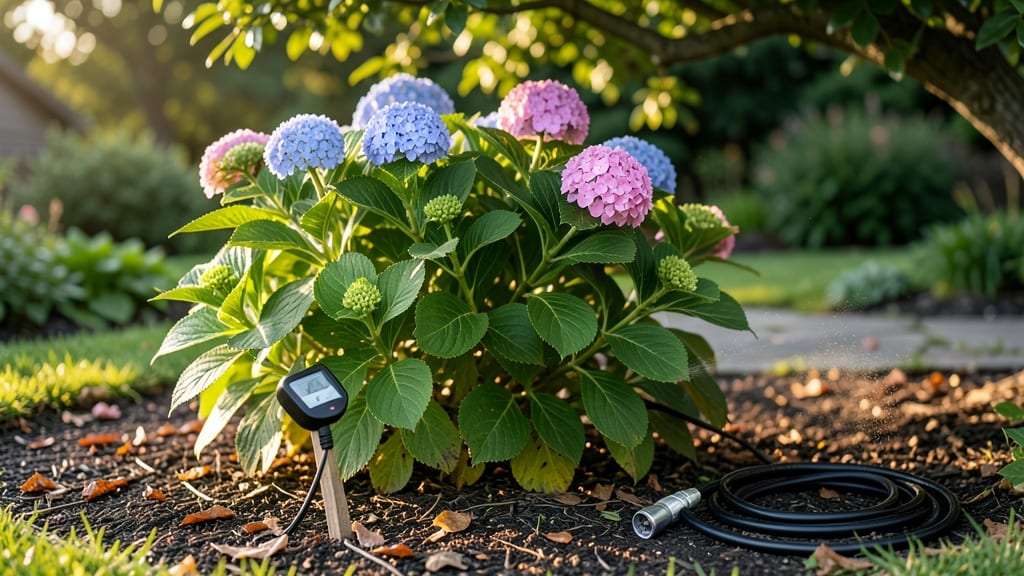
Hydrangeas do not like full sun; they thrive in partial shade with morning sun and afternoon shade, which prevents leaf scorch and wilting while ensuring vibrant blooms. Most varieties prefer 4-6 hours of sunlight daily for optimal growth.
Hydrangeas actually prefer dappled sunlight or filtered shade to avoid the harsh midday rays that can dry out their leaves and cause brown edges. 🌿 The right balance keeps their foliage lush and their flowers vibrant—think of it like giving them a gentle sunbath rather than a full-blown tan.
Different varieties handle light differently, so while some might tolerate a few hours of afternoon sun, others will reward you with bigger blooms when shielded by trees or a well-placed trellis.
For example, bigleaf hydrangeas (the ones with those showy, paper-like flowers) often shift color based on soil pH and light exposure—more sun can push them toward pink, while shade helps maintain blue hues.
Oakleaf varieties, on the other hand, are a bit more forgiving and can handle slightly more sun, especially if their roots stay consistently moist.
💡 In This Article
- How Sunlight Affects Hydrangea Bloom Color and Health
- Best Light Conditions by Hydrangea Variety
How sunlight affects hydrangea bloom color and health
Hydrangeas thrive in partial shade because their leaves are highly sensitive to intense sunlight, which can trigger a process called photoinhibition.
This occurs when excess light energy damages the chlorophyll in leaves, causing them to produce harmful free radicals that lead to brown, crispy edges—a condition known as leaf scorch.
The ideal light scenario mimics the dappled sunlight found under tall trees, where leaves receive bright but indirect rays for 4-6 hours daily, typically in the morning when UV radiation is less intense.
The science behind their color shifts is fascinating: bigleaf hydrangeas (like Hydrangea macrophylla) produce anthocyanins—pigments that determine whether flowers appear blue or pink. In shadier conditions, the plant produces more delphinidin (blue pigment) due to lower soil pH, while sunlight exposure increases cyanidin (red/pink pigment).
For example, the 'Nikko Blue' variety will fade to pink if given too much direct sun, while 'Endless Summer' may develop uneven coloration if light conditions fluctuate dramatically. 🌸
Moisture retention is another critical factor. Hydrangeas have broad leaves that lose water rapidly in full sun, forcing the plant to expend energy on transpiration instead of blooming. This is why afternoon shade is crucial—it reduces evaporation rates by up to 40% compared to full sun exposure.
Think of it like wearing a wide-brimmed hat on a sunny day: it protects the plant's delicate foliage while still allowing it to photosynthesize efficiently.
Temperature also plays a role in light tolerance. In hot climates (zones 7-9), hydrangeas may need even more shade to prevent wilting, while cooler regions (zones 3-6) can handle slightly more sun.
For instance, in Atlanta (zone 7b), afternoon shade is essential, whereas in Portland (zone 8a), morning sun with afternoon shade works best. The key is observing your plant: if leaves curl or flowers droop by midday, it's a sign they're getting too much direct sunlight.
For container-grown hydrangeas, light management becomes even more critical. Pots dry out faster, and roots can't seek shade like in-ground plants. Using light-colored containers (which reflect heat) and placing them near north-facing walls or under patio umbrellas can create the perfect microclimate.
Mulching with 3-4 inches of organic matter also helps retain moisture and regulate soil temperature, mimicking the natural shade of forest floors where many hydrangeas originate.
What most gardeners overlook is how light quality changes with seasons. In summer, the sun's angle is higher, increasing UV exposure, while winter light is softer and less damaging. Adjusting shade structures (like moving a lattice or trimming nearby trees) can help maintain consistent conditions.
For example, a 50% shade cloth placed over hydrangeas during peak summer hours can reduce leaf stress without completely blocking light, which is essential for photosynthesis.