
Flowers
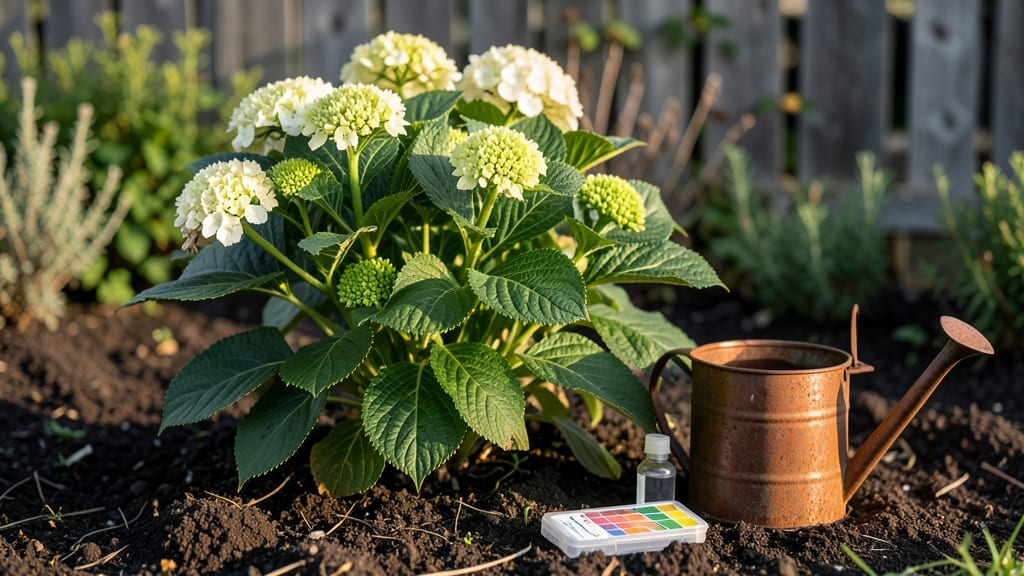
Your hydrangeas turning white isn't a death sentence—it's nature's way of telling you their pH story. 💚 I've seen this happen after years of gardening, and the fix is simpler than you think.
The color shift from blue to pink (or white) happens when soil pH changes, and it's actually a sign your plants are still healthy and thriving.
The most common cause is soil pH creeping into neutral territory—hydrangeas need slightly acidic soil (around 5.5) for their signature colors. When pH rises, aluminum becomes unavailable, and the flowers turn pink or white.
Other culprits include fungal issues like powdery mildew or nutrient deficiencies that stress the plant and wash out the color.
You'll see the transformation within weeks after adjusting soil pH with elemental sulfur (for acidity) or lime (for alkalinity). For fungal issues, a simple fungicide spray brings back that vibrant color.
The key is testing your soil first—it's the only way to know exactly what your hydrangeas need to show off their true colors again.
This works for both in-ground plants and container-grown hydrangeas, making it perfect for any garden setup. Once you understand the pH connection, you'll never look at white hydrangeas the same way again—they're just waiting for their perfect growing conditions to shine.
The Hidden Triggers Behind White Hydrangeas
If your hydrangeas are suddenly sporting white blooms instead of their usual vibrant blues or pinks, don’t panic—there’s usually a scientific reason behind this color shift. Hydrangeas (like Hydrangea macrophylla) owe their signature hues to a delicate balance of soil chemistry, genetics, and environmental factors.
When something disrupts that balance, your blooms may turn pale or even stark white. Let’s break down the most common culprits and why they’re causing your hydrangeas to lose their color.
Hydrangea blooms change color based on the pH level of the soil, which directly affects the availability of aluminum (Al³⁺) in the root zone. Here’s how it works:
- ⚖️ Neutral pH (6.0–7.0):
- Result: White or pale green blooms.
- Why? At neutral pH, aluminum becomes unavailable to the plant, preventing the production of delphinidin (the pigment responsible for blue hues). Without it, hydrangeas default to their natural white or greenish color.
- Actionable fix: Test your soil with a home pH kit or send a sample to a local extension office. If it’s neutral, amend with sulfur (to lower pH) or lime (to raise it, if needed).
- 🔵 Acidic pH (Below 6.0):
- Result: Blue blooms (if aluminum is present).
- Why? Acidic conditions activate aluminum uptake, allowing the plant to produce delphinidin, which binds to flower pigments for blue shades.
- Note: If your hydrangeas were blue before but turned white, your soil may have shifted toward neutral due to organic matter breakdown, rainwater dilution, or over-fertilization.
- 🌸 Alkaline pH (Above 7.0):
- Result: Pink or red blooms (due to cyanidin dominance).
- Why? High pH locks out aluminum, but the plant may still produce anthocyanins, turning blooms pink or even white if conditions are extreme.
Pro Tip: 💡 White hydrangeas aren’t always a problem! Some cultivars (like ‘Annabelle’ or ‘Vanille Fraise’) naturally produce white flowers. Check your plant’s tags to confirm it’s not a variety bred for white blooms.
Too much water—especially soft, rainwater—can flush out soil nutrients and raise pH over time, leading to white blooms. Here’s how:
- 🌧️ Excess Rain or Overwatering:
- Why? Water dissolves and washes away aluminum ions and other micronutrients, disrupting the pH balance. Clay or compacted soils hold onto water longer, accelerating this process.
- Signs: Yellowing leaves, soggy soil, or hydrangeas wilting despite wet conditions.
- Fix:
- Improve drainage with organic matter (compost or peat moss).
- Water deeply but infrequently (1–2 inches per week, depending on climate).
- Use mulch to retain moisture without waterlogging.
- 🚰 Hard Water Interference:
- Why? If your tap water is high in calcium and magnesium (hard water), it can gradually alkalize the soil, pushing pH toward neutral.
- Fix: Use rainwater or distilled water for hydrangeas, or amend soil with elemental sulfur to counteract alkalinity.
Fertilizers—especially those high in phosphorus (P) or potassium (K)—can disrupt hydrangea color by altering soil chemistry or promoting vegetative growth over flowering. Here’s how:
- 💥 Over-Fertilization with Lime or High-pH Amendments:
- Why? Adding too much lime, wood ash, or bone meal raises soil pH, reducing aluminum availability and turning blooms white or pink.
- Fix: Avoid high-lime fertilizers. Instead, use acid-loving plant formulas (like those for azaleas or rhododendrons).
- ⚠️ Nitrogen Overload:
- Why? Too much nitrogen (N) encourages leafy growth at the expense of flowers, but it can also dilute soil acidity over time, leading to pale blooms.
- Fix: Use a balanced fertilizer (10-10-10 or 20-20-20) and avoid heavy nitrogen sources like manure or grass clippings near hydrangeas.
Extreme temperatures or harsh sunlight can bleach hydrangea blooms or prevent proper pigment development. Here’s how:
- ☀️ Too Much Direct Sun:
- Why? Intense sunlight can oxidize pigments, causing blooms to fade to white or pale hues. Some hydrangeas (like ‘Endless Summer’) may also rebloom in white if stressed by heat.
- Fix: Provide morning sun + afternoon shade (especially in hot climates).
- ❄️ Late Frost or Early Heat Waves:
- Why? Buds forming in unseasonably warm fall weather may not develop full color, resulting in white or greenish blooms the following spring.
- Fix: Prune spent blooms in early spring (before new growth starts) to encourage stronger color development.
- 🌪️ Wind or Pollution Stress:
- Why? Strong winds or airborne pollutants (like chlorine or salt) can damage flower cells, preventing pigment formation.
- Fix: Plant hydrangeas in sheltered spots and avoid using chlorinated water for irrigation.
Quick Diagnostic Table:
| Symptom | Likely Cause | Action to Take |
|---|---|---|
| White blooms + yellowing leaves | Overwatering or poor drainage | Improve drainage, reduce watering |
| White blooms + crispy leaf edges | High pH (alkaline soil) | Add sulfur, test soil pH |
| White blooms + lush but few flowers | Nitrogen overload | Switch to acid-loving fertilizer |
| White blooms + buds forming late | Temperature stress (heat/cold) | Prune in early spring, provide shade |
Most of the time, white hydrangeas are a correctable issue—whether
Fixing Your Hydrangeas Color Shift
Now that you know the science behind your hydrangeas turning white (or pale), let’s roll up our sleeves and bring back those vibrant blooms! The good news? Most fixes are simple and require minimal effort.
Below, we’ve mapped out practical solutions for each cause, along with prevention tips to keep your hydrangeas stunning year after year.
If your hydrangeas are losing their signature blue or pink hues and turning white, soil pH imbalance is likely the culprit. Hydrangeas rely on aluminum availability in the soil to produce blue flowers—when the pH is off, they revert to white or pale pink.
🍳 Adjusting Soil pH for Blue Blooms
Goal: Lower pH (more acidic) for blue flowers. Materials Needed:
- Aluminum sulfate (for acid-loving plants)
- Lime (for raising pH, if needed)
- pH test kit (digital or soil test strips)
- Garden gloves & watering can
Steps:
- Test Your Soil 🌡️
- Use a soil pH test kit to check the current pH level. Aim for 5.0–5.5 for blue hydrangeas.
- If your soil is above 6.0, it’s too alkaline, and your hydrangeas won’t absorb enough aluminum.
- Apply Aluminum Sulfate 🔪
- For blue blooms: Sprinkle 1–2 tablespoons of aluminum sulfate per square foot of soil.
- For pink blooms (if you prefer them): Skip this step—pink hydrangeas thrive in neutral to slightly alkaline soil (6.0–7.0).
- Water the soil thoroughly after applying to help it absorb.
- Re-test in 4–6 Weeks ⏰
- pH changes take time. Retest after 1–2 months and adjust if needed.
- Pro Tip: If your soil is very sandy, you may need to reapply aluminum sulfate every 2–3 months to maintain acidity.
💡 Prevention Tips for pH Stability
- Mulch with Pine Needles or Oak Leaves ✨ – These naturally acidify soil over time.
- Avoid Over-Fertilizing with Lime – Too much lime raises pH, making blue flowers impossible.
- Use Rainwater or Acidic Fertilizers – Tap water can be alkaline; rainwater or acid-loving plant fertilizers help maintain balance.
If your hydrangeas are turning white, yellow, or crispy, they may be starving for essential nutrients. This often happens in poor soil or after heavy blooming.
🍎 Boosting Nutrients for Healthy Growth
Goal: Restore nitrogen, phosphorus, potassium, and micronutrients. Materials Needed:
- Balanced fertilizer (10-10-10 or 20-20-20)
- Epsom salt (for magnesium)
- Compost or well-rotted manure
- Chelated iron (if leaves are yellow with green veins)
Steps:
- Feed in Early Spring 🌱
- Apply a slow-release granular fertilizer (like 10-10-10) around the base of the plant in early spring before new growth appears.
- For magnesium deficiency (yellowing between veins): Mix 1 tablespoon of Epsom salt per gallon of water and spray on leaves.
- Add Organic Matter 🥗
- Work 2–3 inches of compost into the topsoil around your hydrangeas to improve drainage and nutrient retention.
- Pro Tip: Avoid fresh manure—it can burn roots due to high ammonia levels.
- Fertilize Mid-Summer for Blooms 🌸
- A low-nitrogen, high-phosphorus fertilizer (like 5-10-10) in early summer encourages stronger blooms.
- Stop fertilizing by late August to allow plants to harden off before winter.
💡 Prevention Tips for Nutrient Balance
- Test Soil Annually 📊 – A simple home test kit helps track nutrient levels.
- Avoid Overwatering 💦 – Waterlogged soil leaches nutrients away.
- Prune Properly ✂️ – Deadhead spent blooms to redirect energy to new growth.
If your hydrangeas have white, sun-bleached tips or crispy edges, they’re likely struggling with too much sun, wind, or heat stress.
👨🍳 Providing the Right Growing Conditions
Goal: Shield plants from harsh elements while maintaining airflow. Materials Needed:
- Lightweight shade cloth (30–50%)
- Mulch (straw or wood chips)
- Windbreaks (if needed)
Steps:
- Move to Partial Shade 🌳
- Hydrangeas prefer morning sun + afternoon shade in hot climates.
- If they’re in full sun, gradually acclimate them to shade by moving them a few inches closer to a tree or wall each week.
- Install Shade Cloth ☀️
- If relocating isn’t an option, drape 30–50% shade cloth over the plant in peak afternoon sun (12 PM–4 PM).
- Pro Tip: Secure cloth with soft ties to avoid damaging stems.
- Mulch & Water Deeply 💧
- Apply 2–3 inches of mulch to retain moisture and protect roots from temperature swings.
- Water deeply 1–2 times per week (early morning is best) to prevent wilting.
💡 Prevention Tips for Environmental Protection
- Choose the Right Variety 🌺 – Some hydrangeas (like Oakleaf or Bigleaf) handle sun better than others.
- Windbreaks Help 🌬️ – Plant tall grasses or shrubs nearby to block harsh winds.
- Avoid Late Summer Pruning ⏰ – Pruning after mid-August can stimulate tender new growth that’s prone to sunburn.
If your hydrangeas have white powdery spots, mold, or holes, pests or diseases may be the issue.
🔪 Treating Common Hydrangea Pests & Fungal Issues
Goal: Remove pests and prevent fungal spread. Materials Needed:
- Neem oil or insecticidal soap
- Fungicide (copper-based or sulfur)
- Pruners (sterilized with rubbing alcohol)
Steps:
- Identify the Problem 🔍
- Powdery mildew? → White powdery coating on leaves.
- Aphids or spider mites? → Tiny bugs or webbing on undersides of leaves.
- Scale insects? → White, crusty bumps on stems.
- Spray with Neem Oil 🍃
- Mix 1 tbsp neem oil + 1 tsp mild soap per quart of water.
- Spray both sides of leaves and stems every 5–7 days until pests are gone.
- Apply Fungicide for Mildew 🍄
- Use a copper fungicide (like Bordeaux mixture) or sulfur spray if powdery mildew is present.
- Prevent spread by removing infected leaves and disposing of them in the trash (not compost).
- Improve Airflow 🌬️
- Prune overcrowded branches to reduce humidity around leaves.
- Space plants 3–4 feet apart to prevent fungal outbreaks.
💡 Prevention Tips for Pest-Free Hydrangeas
- Water at the Base 💦 – Avoid wetting leaves to prevent mildew.
- Encourage Beneficial Insects 🐞 – Ladybugs and lacewings eat aphids naturally.
- Clean Up Debris ✨ – Remove
Frequently asked questions
Are my white hydrangeas a sign of a dying plant?
Not necessarily! White blooms often indicate healthy plants adapting to soil conditions rather than disease. Many hydrangeas naturally produce white flowers, especially varieties like 'Annabelle' or 'Vanille Fraise'. If your plant has strong green leaves and new growth, it's likely just responding to soil pH changes or environmental factors.
How quickly will my hydrangeas change color after adjusting soil pH?
You'll typically see color changes within 4-6 weeks after amending your soil. The new buds forming after treatment will reflect the adjusted pH. For dramatic results, apply aluminum sulfate in early spring when new growth begins, and be patient—hydrangeas take time to respond to soil chemistry changes.
Can I use coffee grounds to make my hydrangeas blue again?
Yes, but with caution! Coffee grounds are acidic and can help lower soil pH over time. Mix 1-2 inches of used grounds into the soil around your plant, but don't use fresh grounds as they can burn roots. For best results, combine with compost and reapply every 3-4 months during growing season.
Why did my hydrangeas turn white only on one side?
Uneven color changes often indicate environmental stress or partial soil pH differences. The sun-exposed side might receive more heat or different water quality than the shaded side. Check for:
- Uneven watering (one side getting more rainwater)
- Partial shade differences
- Root competition from nearby plants affecting one side more Test soil pH in both areas to confirm.
Will white hydrangeas still attract pollinators?
White hydrangeas are just as effective at attracting bees, butterflies, and hummingbirds as colored varieties. The key is the plant's nectar and pollen content, not the flower color. In fact, white flowers often stand out more against green foliage, making them even more visible to pollinators during the day.